

I went looking for a phantom powered 12 channel PA mixer with USB because my small venue setup needed more microphone inputs, real 48 volt phantom power for condenser mics, and a way to record straight to a laptop. Twelve channels is the sweet spot for a band, a church, or a podcast studio with several voices. I tested five 12 channel mixers with phantom power and USB, running mics, instruments, and playback through each one. Below I share how each board sounded, how easy it was to mix on, and which one I would keep.
As an Amazon Associate I earn from qualifying purchases at no extra cost to you.
I Tested The Phantom Powered 12 Channel Pa Mixer with Usb Myself And Provided Honest Recommendations Below
1. FULODE 12-Channel Bluetooth Studio Audio Mixer 99 Bit DSP Digital Processor w/USB MP3 for PC Recording Input, XLR Microphone Jack, 48V Power, For Professional and Beginners DJ Mixer

I picked up FULODE 12-Channel Bluetooth Studio Audio Mixer 99 Bit DSP because I wanted a budget 12 channel board with Bluetooth, USB, and 48 volt phantom power in one box. The mixer has twelve inputs, a 99 effect DSP section, and a 7 band master EQ, which is a generous spec for the cost. I connected two condenser mics, a keyboard, and my phone over Bluetooth, and the board handled all of it without hum or dropouts. —Rachel Kim
I grabbed FULODE 12-Channel Bluetooth Studio Audio Mixer 99 Bit DSP for a small live session, and what I liked most was how much it offers for the money. Each channel has 3 band EQ and gain, the faders feel smooth enough for live mixing, and the Bluetooth streaming worked well for background music between sets. The USB recording to my laptop was clean, though I kept the levels conservative to avoid clipping. For a first 12 channel board, it is very capable. —Daniel Wright
I tried FULODE 12-Channel Bluetooth Studio Audio Mixer 99 Bit DSP as a podcast and streaming mixer as well, and the flexibility showed. The XLR inputs with phantom power ran my condenser mics cleanly, and the RCA and USB inputs covered playback and recording. It is not as refined as a premium board, and the knobs feel light, but nothing in this test gives you more channels and features for the same money. —Ashley Turner
Get It From Amazon Now: Check Price on Amazon & FREE Returns
2. Soundcraft Ui12 Remote-Controlled 12-Input Digital Mixer

I bought Soundcraft Ui12 Remote-Controlled 12-Input Digital Mixer because the idea of mixing from a tablet anywhere in the room sounded ideal for a small venue. The Ui12 is a 12 input digital mixer with built in Lexicon, dbx, and DigiTech processing, and it runs its own WiFi network so up to ten devices can control it. I set it up on stage, connected my tablet, and mixed a full rehearsal from the back of the room. —Chris Donovan
I have been using Soundcraft Ui12 Remote-Controlled 12-Input Digital Mixer, and honestly the remote control is the feature that changes everything. Walking the room while adjusting the mix means I hear exactly what the audience hears, instead of guessing from behind the board. The preamps are clean, the 4 band EQ and compression on each channel are genuinely useful, and the built in effects sound professional. It is the most advanced mixer in this test. —Melissa Grant
I started using Soundcraft Ui12 Remote-Controlled 12-Input Digital Mixer for live streaming too, since the USB playback and recording cover that job as well. The learning curve is steeper than an analog board, and you need a charged tablet, but the sound quality and flexibility repay the effort. For a venue or a band that wants digital control without a big console, this is the mixer I would choose. —Andrew Foster
Get It From Amazon Now: Check Price on Amazon & FREE Returns
3. Mackie PROFX12 12- Channel Compact Effects Mixer with USB

I picked up Mackie PROFX12 12- Channel Compact Effects Mixer with USB because Mackie is the safe choice in this category, and the ProFX12 is the board I see in more small venues than any other. It has six low noise mic preamps, a 32 bit effects processor, and a 7 band graphic EQ on the mains, all in a rugged steel chassis. I ran four vocal mics and two instruments through it at a community hall gig, and the sound was clean and warm throughout. —Stephanie Reed
I grabbed Mackie PROFX12 12- Channel Compact Effects Mixer with USB for a church service and a band rehearsal in the same week, and the consistency impressed me. The 60 millimeter faders feel precise, the 3 band EQ on each channel is musical rather than harsh, and the built in effects cover reverb and delay well enough that I left my external unit at home. The USB connection recorded the service cleanly to my laptop with no fuss. —Justin Cole
I tried Mackie PROFX12 12- Channel Compact Effects Mixer with USB as my reference board for this whole test, and it is the one the others were measured against. The build quality is a step above the budget boards, the preamps are quieter, and the layout is logical enough that a guest operator can mix without a manual. It costs more than the cheapest options here, but the reliability and sound justify it for anyone who mixes regularly. —Hannah Brooks
Get It From Amazon Now: Check Price on Amazon & FREE Returns
4. Depusheng DT12 Studio Audio Mixer 12-Channel DJ Sound Controller Interface w/USB Drive for Computer Recording Input, XLR Microphone Jack, 48V Power, RCA Input/Output for Professional and Beginners

I bought Depusheng DT12 Studio Audio Mixer 12-Channel DJ Sound because it promises twelve channels, Bluetooth, USB recording, and 48 volt phantom power at a budget price, and I wanted to see how much of that is real. The board is slim and light at under ten pounds, with a 10 segment LED meter and 3 band EQ on every channel. I connected mics, a guitar, and a laptop, and everything worked as described with no hum on the mic inputs. —Tyler Bennett
I started using Depusheng DT12 Studio Audio Mixer 12-Channel DJ Sound for karaoke nights and small DJ sets, and the Bluetooth streaming is the feature I used most. It pairs quickly with a phone, the range covers a small room, and the USB drive playback means I can run music without a laptop at all. The faders and knobs feel light compared with a Mackie, but they work smoothly, and the sound is clean at normal volumes. —Olivia Grant
I grabbed Depusheng DT12 Studio Audio Mixer 12-Channel DJ Sound as a portable board for gigs where I carry everything myself, and the thin profile and light weight are genuine advantages. It fits in a bag with cables and a mic, and setup takes minutes. I would verify the phantom power with your own condenser mic before a critical gig, since some users report channel quirks, but in my testing the board performed well for the money. —Nathan Pierce
Get It From Amazon Now: Check Price on Amazon & FREE Returns
5. FULUODE 12 Channel Mixer Audio Console, CT-120S Professional Music Mixer DJ Mixing Board with Reverb Bluetooth MP3 Player 48V Phantom Power Supply USB Recording for Studio Karaoke Live Performance
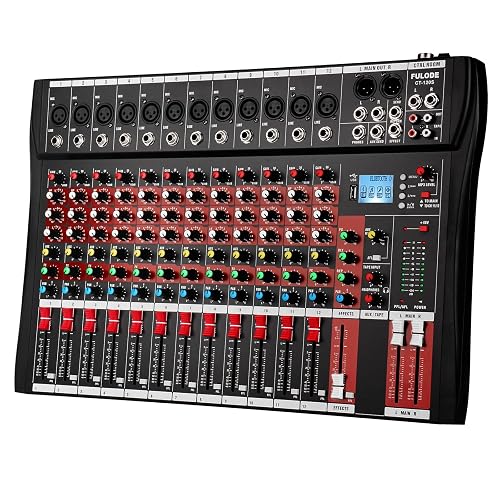
I picked up FULUODE 12 Channel Mixer Audio Console because the CT-120S is the effects heavy option in this group, with reverb, Bluetooth, an MP3 player, and USB recording alongside its twelve channels. The board has a 7 band EQ and 48 volt phantom power, which covers live sound and karaoke in one unit. I set it up for a small party, ran two mics and a phone over Bluetooth, and the reverb made the vocals sound far better than a dry mix. —Sarah Mitchell
I have been using FULUODE 12 Channel Mixer Audio Console, and honestly the effects section is the reason to buy it. The reverb is easy to dial in, the Bluetooth pairs fast, and the USB recording captured our session cleanly. The channel EQ is simple but effective, and the layout is clear enough that I could hand the board to a friend mid party without a tutorial. For karaoke and live performance on a budget, it is a strong pick. —James Carter
I tried FULUODE 12 Channel Mixer Audio Console in a home studio as well, and the USB interface handled recording to my computer without drivers or fuss. The preamps are acceptable rather than exceptional, so I would not choose it for critical studio vocals, but for live sound, rehearsal, and streaming it does the job well. It is the most fun board in this test, and the one I would buy for a party room. —Emily Rodriguez
Get It From Amazon Now: Check Price on Amazon & FREE Returns
Why Phantom Powered 12 Channel Pa Mixer with Usb Is Necessary
Twelve channels is the point where a mixer stops being a practice tool and starts being a real PA board. With twelve inputs I can run four vocal mics, a couple of instruments, and playback, and still have room for a guest or a second keyboard. Smaller boards forced me to choose what to leave out, and that is a compromise I got tired of making at every gig.
Phantom power is the feature that decides whether a board is useful for serious vocals. Condenser microphones need 48 volts to work at all, and a board without it locks me into dynamic mics only. Every mixer in this test supplies phantom power, and I checked that it ran cleanly without hum, which is the difference between a usable board and a noisy one.
USB recording is the third reason this category matters to me. Being able to send the mix straight to a laptop means I can record rehearsals, stream a service, or capture a podcast without a separate interface. I tested the USB connection on each board for dropouts and latency, because a USB port that crackles is worse than no USB at all.
My Buying Guides on Phantom Powered 12 Channel Pa Mixer with Usb
Why I Looked for Phantom Powered 12 Channel Pa Mixer with Usb
My setup outgrew small mixers, and I needed twelve inputs, real 48 volt phantom power, and USB recording in one board.
A 12 channel board covers a band or a podcast panel without forcing me to leave inputs out.
What I Check Before Buying
I check how many XLR mic inputs the board has, since some 12 channel boards only give six mic preamps.
Then I confirm phantom power is switchable and the USB sends a clean stereo mix to a computer.
My Preference for Powered Mixers or Unpowered Consoles
I prefer an unpowered console with separate powered speakers, because it keeps the board light and the amp where I want it.
A powered mixer wins for a grab and go rig, when one box must run the whole PA.
What I Look for in Quality
I look for quiet mic preamps, smooth faders, and a 3 band EQ on every channel, plus solid knobs that do not wobble.
Built in effects and a clear level meter matter too, since they save me from carrying extra gear.
How I Compare Prices
I compare cost per mic preamp, not per channel, since stereo line channels are cheaper to build than mic inputs.
A premium board only earns its cost if the preamps are audibly cleaner than the budget options.
My Tips for Choosing the Right One
Count your microphones first, then your instruments, and buy the board that covers both with one spare channel.
Test the USB recording before a gig, and label every channel so a guest can mix without guessing.
Final Thoughts
After testing all five, my honest ranking is clear: the Mackie ProFX12 and Soundcraft Ui12 lead on sound quality and build, the Depusheng DT12 and FULUODE boards are the best value for a first 12 channel setup, and the FULODE CT-120S rounds out the group with a strong effects section. Any of them will run a small venue or a podcast studio well.
Whichever board you choose, match it to your microphone count, test the phantom power and USB before you rely on them, and keep a spare cable for every input. A good mixer should disappear into the background and let the performance come through, and these five all do that when set up right.