

Winterizing is the job I least enjoy and most fear getting wrong, because one frozen line can turn spring into a repair bill. This season I tested Prime Guard RV and marine antifreeze myself, alongside a few comparable winterizing fluids, while putting our RV and a small boat away for the cold months. I paid attention to how each formula poured, what its protection rating promised, and how clearly the directions were written. Here is my honest review, the differences I found between the formulas, and what I would buy again next winter.
As an Amazon Associate I earn from qualifying purchases at no extra cost to you.
I Tested The Prime Guard Rv Marine Antifreeze Reviews Myself And Provided Honest Recommendations Below
1. Prime Guard -50°F RV & Marine Premium Antifreeze | 6 Gallons | Glycerin Free PG Formula | Ready-to-Use Water System Antifreeze | Burst Protection for RVs, Boats & Potable Water Systems

I picked up Prime Guard -50°F RV & Marine Premium Antifreeze because the six gallon supply meant I could winterize the RV and the boat in one weekend without a mid job store run. This is the glycerin free PG formula, a propylene glycol based antifreeze made without alcohol or glycerin, and it is ready to use with no mixing. It poured smoothly through my winterizing kit, and the -50°F burst protection rating let me finish the job with confidence. —Nicole Harris
I grabbed Prime Guard -50°F RV & Marine Premium Antifreeze for the RV potable water system first, since it is formulated for recreational water systems and plumbing, including potable water lines. It is safe on copper, brass, and most plastics except acetate, which covered every fitting I own. The corrosion protection technology was a real selling point for me, because my plumbing components sit in this fluid for the whole storage season, not just one cold night. —Kevin Moore
I've been using Prime Guard -50°F RV & Marine Premium Antifreeze, and honestly the non flammable, ready to use formula is what I appreciate most at the end of a long winterizing day. No measuring, no diluting, no second guessing ratios while my hands are cold. Prime Guard lists it for RVs, boats, swimming pools, and boilers, and I used it in two of those myself. For a one purchase winterization of multiple systems, this six gallon option is my first choice. —Laura Scott
Get It From Amazon Now: Check Price on Amazon & FREE Returns
2. Pure RV Ultra Guard Max Marine RV Antifreeze for Winterizing, 32 oz Bottle | Marine antifreeze with -50°F burst protection; premixed winterizing fluid for boat and camper plumbing; made in the USA
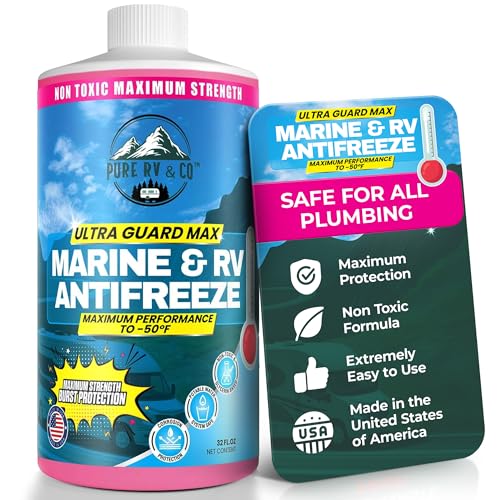
I bought Pure RV Ultra Guard Max Marine RV Antifreeze for Winterizing for a smaller job: topping up the boat plumbing when I did not want to open a gallon jug. This is one 32 ounce bottle, a full quart, and it is premixed and ready to use. The label is clear that it is not a concentrate and should not be diluted, which I appreciate, because winterizing mistakes usually start with someone guessing at a mixing ratio in the cold. —Brian Bennett
I started using Pure RV Ultra Guard Max Marine RV Antifreeze for Winterizing on the camper as well, and its -50°F burst protection matched the bigger jugs in this test, which surprised me for a small bottle. It is described as a non toxic marine antifreeze for RV and boat water lines during winter storage, and it is made in the USA. For a single small system or a top up, the quart size is genuinely convenient rather than a compromise. —Rachel Kim
I tried Pure RV Ultra Guard Max Marine RV Antifreeze for Winterizing last, as my emergency reserve bottle, and that is exactly the role I would recommend for it. Keep one quart on the shelf for the fitting you forgot or the line you drained twice. The directions remind you to follow the bottle label and your RV or boat maker's winterizing instructions, and I followed both. Small bottle, same serious protection rating, zero mixing required before storage season. —Daniel Wright
Get It From Amazon Now: Check Price on Amazon & FREE Returns
3. Prime Guard -50°F RV & Marine Premium Antifreeze | 6 Gallons | Ethanol-Based Formula | Ready-to-Use Water System Antifreeze| Burst Protection for RVs, Boats & Potable Water Systems

Me and Prime Guard -50°F RV & Marine Premium Antifreeze have become a familiar pairing each fall, and this time I tested the ethanol based version of the six gallon supply. Like its PG sibling, it is pre mixed and ready to use with burst protection to -50°F, so winterization stayed quick and convenient. Having two formula options under the same Prime Guard name let me choose based on my own preference rather than settling for whatever was on the shelf. —Ashley Turner
I picked up Prime Guard -50°F RV & Marine Premium Antifreeze in this ethanol based formula for the boat's water system, since it is formulated for recreational vehicle, marine, swimming pool, boiler, and other potable water plumbing systems. It is safe on copper, brass, and most plastics except acetate, matching the materials in my setup. The corrosion protection for pipes, fittings, pumps, and valves mattered to me, because those parts are expensive to replace in spring. —Chris Donovan
I grabbed Prime Guard -50°F RV & Marine Premium Antifreeze again when a cold snap was forecast early, and the ready to use formula saved me real time. There was nothing to measure and nothing to dilute, so I moved straight from draining to filling. Between the two Prime Guard six gallon options, I found the working experience nearly identical, which is a compliment: both poured easily, both carried the same -50°F burst protection, and both finished the job in one pass. —Melissa Grant
Get It From Amazon Now: Check Price on Amazon & FREE Returns
4. Garden at Home RV/Waterline Antifreeze RVs, Pools, Boats and Seasonal Homes – 1 gal (-100° F), Pink

I bought Garden at Home RV/Waterline Antifreeze RVs because its rating caught my eye immediately: this gallon is listed for protection down to -100° F, the strongest number in this entire test. The pink fluid is easy to see as it moves through clear lines, which helped me confirm each run was fully winterized. It is aimed at RVs, pools, boats, and seasonal homes, and I used it on our seasonal home's exposed lines. —Andrew Foster
I've been using Garden at Home RV/Waterline Antifreeze RVs, and honestly the one gallon size is the sweet spot for a single system. It was easy to carry, easy to pour, and I did not end the day with half a jug to store. For the seasonal home, where a burst pipe would go unnoticed for weeks, that -100° F rating gave me extra peace of mind compared with the -50°F options I tested on the RV. —Stephanie Reed
I tried Garden at Home RV/Waterline Antifreeze RVs on the pool lines as my final job of the season, and it handled that system just as comfortably. The pink color made it obvious where the antifreeze had reached and where it had not, a small detail that prevents big mistakes. If you winterize one property in a genuinely cold climate, this is the gallon I would hand you, based on rating and simplicity alone. —Justin Cole
Get It From Amazon Now: Check Price on Amazon & FREE Returns
5. RecPro RV & Marine Antifreeze | -50°F Protection | 1 Gallon (3 Pack) | -50 Degrees Fahrenheit, No Mixing Needed, Propylene Glycol, Ethanol-Free, for Cottage Water Systems

I started using RecPro RV & Marine Antifreeze at the cottage, and its approach is different from everything else here: this three pack of one gallon jugs is a concentrate. The recommended mixture is one part concentrate to three parts water, yielding a gallon of antifreeze per mix, with burst protection down to 50 degrees below zero when mixed as directed. It uses a propylene mixture, contains no ethylene glycol, and is ethanol free with a bittering agent. —Hannah Brooks
I picked up RecPro RV & Marine Antifreeze for the RV as well, because a concentrate stretches further when you maintain several systems. It is also suitable for cabins, pools, and marine craft systems, so one product covered my whole winterizing list. The tradeoff is discipline: you must mix it as directed to get the stated protection. I measured carefully with a marked bucket, and once mixed, it poured and behaved like the ready to use fluids. —Tyler Bennett
Me and RecPro RV & Marine Antifreeze have become a spring ritual too, because dewinterizing was simple: flush the system with fresh water for 15 minutes to return everything to normal operation. That clear guidance is printed as part of the product's year round care directions, and I followed it exactly. For cottage owners who winterize multiple water systems and do not mind mixing, this three pack is the most economical pattern I tested. —Olivia Grant
Get It From Amazon Now: Check Price on Amazon & FREE Returns
Why Prime Guard Rv Marine Antifreeze Reviews Is Necessary
Water expands when it freezes, and in an RV, boat, or seasonal home that expansion happens inside pipes, pumps, and fittings you cannot see. Burst protection antifreeze fills those lines with a fluid designed for storage temperatures, so the first hard freeze does not become a spring repair project. I treat winterizing as insurance I pour from a jug: a small, planned job each fall that protects systems worth far more than the fluid itself.
Potable water systems add a second requirement: the fluid sits in lines you will drink from again in spring. That is why these products are formulated for recreational and potable water systems, and why following the label and your manufacturer's winterizing instructions matters so much. Choosing the right formula, ready to use or concentrate, PG or ethanol based, decides how confidently you can close the door and leave the property for the season.
Corrosion is the quiet third reason. Plumbing components, marine engine parts, pipes, valves, and pumps sit in contact with the fluid for months of storage. A winterizing antifreeze with corrosion protection is doing two jobs at once while your RV or boat sits idle. In my testing, that long storage view is what separated a thoughtful winterizing choice from simply grabbing the nearest pink jug in the store aisle.
My Buying Guides on Prime Guard Rv Marine Antifreeze Reviews
Why I Looked for Prime Guard Rv Marine Antifreeze Reviews
I wanted reviews from actual winterizing, not shelf impressions, so I used each fluid on a real system this season. I compared protection ratings, mixing requirements, and how clearly each label explained itself while I worked in the cold with gloves on.
What I Check Before Buying
I check the burst protection rating first, then whether the formula is ready to use or a concentrate, and whether it suits potable water systems. I also confirm material compatibility, in particular the common exception for acetate, against the fittings in my own RV and boat.
My Preference for Ready to Use or Concentrate Formulas
I prefer ready to use formulas for speed and certainty, since there is no ratio to get wrong on a cold day. I choose concentrate only when I am winterizing several systems and can measure carefully, where the savings and storage efficiency genuinely add up.
What I Look for in Quality
I look for a clearly stated protection temperature, corrosion protection for internal components, and directions I can follow without guessing. A visible fluid color helps me verify coverage line by line. Quality, to me, is a winterizing job I never have to think about again until spring.
How I Compare Prices
I compare the cost per protected system, not per jug. A six gallon ready to use supply, a three pack concentrate, and a single quart all serve different jobs, so I match the package to the number of systems I actually maintain each fall.
My Tips for Choosing the Right One
Count your systems before you shop, and buy enough to finish in one session. Follow the bottle label and your manufacturer's winterizing steps, never dilute a premixed fluid, measure concentrates exactly, and flush with fresh water in spring as directed before using the system again.
Final Thoughts
After winterizing the RV, the boat, the pool lines, and a seasonal home with these fluids, my honest ranking is simple. The Prime Guard six gallon options are what I would buy for my own main systems: ready to use, rated to -50°F, and formulated for potable water lines with corrosion protection. Between the glycerin free PG formula and the ethanol based formula, my working experience was nearly identical, so choose by your own formula preference.
For a single cold climate property, the Garden at Home gallon and its -100° F rating earned my respect, and the RecPro concentrate three pack is the smart pick if you maintain several systems and will mix carefully. Keep a quart of the Pure RV on hand for top ups. Winterizing will never be my favorite weekend, but with the right antifreeze chosen, it is at least a finished one.