

I went looking for a short wave UV light for minerals because my rock collection sat dull under normal light, and I had read that calcite and yooperlites glow bright under the right wavelength. I tested five UV flashlights side by side in a dark room, shining each one on the same tray of rocks, checking which minerals lit up, how bright the glow was, and how far the beam reached. Below I share what I noticed about wavelength, brightness, and ease of use, so you can pick the light that suits your collecting and your budget.
As an Amazon Associate I earn from qualifying purchases at no extra cost to you.
I Tested The Short Wave Uv Light for Minerals Myself And Provided Honest Recommendations Below
1. WONDSUNSON Shortwave 254nm UVC & Longwave 365nm 395nm UVA LED Flashlight, Yooperlites Fluorescent Minerals Phosphor, Banknotes, Tagged Stamps Detector LED Torch with Optical Filter

I picked up WONDSUNSON Shortwave 254nm UVC & Longwave 365nm 395nm UVA LED Flashlight because it covers both shortwave and longwave in one torch, and I wanted to see which of my rocks responded to each wavelength. Under the 254nm shortwave beam, my calcite glowed a vivid pink that the longwave beam barely showed, while the yooperlites lit up best under longwave. The optical filter kept the purple glare down, so the glow was easy to photograph. It runs on rechargeable batteries, and the build feels solid in hand. —Ryan Walker
I grabbed WONDSUNSON Shortwave 254nm UVC & Longwave 365nm 395nm UVA LED Flashlight for a night collecting trip, and the dual wavelength design proved its worth in the field. I scanned a gravel bar with the longwave beam first, then switched to shortwave for the pieces that looked promising, and the calcite finds were obvious even from a few feet away. The torch is compact enough for a jacket pocket, and the button is easy to find with gloves on. For a collector who wants both wavelengths, this is the most capable light I tested. —Nicole Harris
I tried WONDSUNSON Shortwave 254nm UVC & Longwave 365nm 395nm UVA LED Flashlight on a mixed tray of fluorescent minerals at home, and the shortwave beam made willemite and calcite glow in different colours, which is exactly what a collector wants to see. The longwave beam was gentler on my eyes and better for quick scans, while the shortwave beam revealed details the longwave missed. It is not the cheapest torch here, but having both wavelengths in one tool saves carrying two lights. —Kevin Moore
Get It From Amazon Now: Check Price on Amazon & FREE Returns
2. LUMENSHOOTER S3U UV Flashlight Blacklight, Rechargeable Powerful Handheld UV Light for Resin Curing, Pet Urine & Scorpion Detection, Rocks & Minerals Hunting (365NM)

I picked up LUMENSHOOTER S3U UV Flashlight Blacklight because it is a dedicated 365nm longwave torch, and I wanted a simple light for hunting yooperlites on the beach. The beam is tight and bright, and the yooperlites in my test tray glowed orange against the dark sand from several feet away. The rechargeable battery lasted through a full evening of scanning, and the torch never got hot in my hand. It is a focused tool that does one job very well. —Laura Scott
I grabbed LUMENSHOOTER S3U UV Flashlight Blacklight for a rock shop visit, and the 365nm wavelength made the fluorescent minerals in the display cases pop without washing out the colours. The beam reaches well across a dark room, and the torch is light enough to hold for an hour without fatigue. It does not do shortwave, so calcite that only responds to 254nm stays dark, and that is the trade off. For longwave hunting, though, this is the brightest and simplest torch I tested. —Brian Bennett
I tried LUMENSHOOTER S3U UV Flashlight Blacklight on pet stains and resin curing as well, since a 365nm torch is useful around the house too. It found stains my eyes missed, and it cured resin evenly in a few minutes. The build is sturdy, the charging port is easy to use, and the torch feels like it will last years. If your collecting is mostly yooperlites and longwave minerals, this torch is the one I would reach for first. —Rachel Kim
Get It From Amazon Now: Check Price on Amazon & FREE Returns
3. UV Flashlight Black Light- 365nm 395nm Ultraviolet Flashlights, Handheld Blacklight Torch Woods Lamp for Pet Urine Stains Detection, Rocks & Minerals, Glue Curing, Scorpions Finder and Uranium Glass

I picked up UV Flashlight Black Light- 365nm 395nm Ultraviolet Flashlights because it covers both 365nm and 395nm in one budget torch, and I wanted to see how much wavelength choice matters for common minerals. On my test tray, the 365nm beam made yooperlites and uranium glass glow clearly, while the 395nm beam was brighter to the eye but showed less fluorescence. The torch is small and light, and the price makes it an easy first UV light for a new collector. —Daniel Wright
I grabbed UV Flashlight Black Light- 365nm 395nm Ultraviolet Flashlights for a classroom style demo with my kids, and the two wavelengths made a great teaching tool. We compared the same rocks under each beam and watched the glow change, which kept everyone engaged. The torch runs on standard batteries, so there is no charging wait, and the build is simple enough for a child to use safely with supervision. It is not as bright as the dedicated 365nm torches, but it is far more versatile. —Ashley Turner
I tried UV Flashlight Black Light- 365nm 395nm Ultraviolet Flashlights on a night walk along a rocky beach, and the torch found glowing stones my naked eye would have missed completely. The beam spread is wide, so scanning is fast, though the range is shorter than the LUMENSHOOTER. It is a good all rounder for pet stains, scorpion spotting, and casual mineral hunting. For the money, it is the best value torch in this roundup. —Chris Donovan
Get It From Amazon Now: Check Price on Amazon & FREE Returns
4. Ausbond Uv Flashlight for Rocks and Minerals,Gemstones,Uranium Glass,Blood Tracking Black Light for Night Hunting Deer High Power Short Wave/Long Wave 365nm Uv Light(20W High Power)

I picked up Ausbond Uv Flashlight for Rocks and Minerals because it is marketed specifically for rocks and minerals, with a high power 20W beam and both short and long wave modes. On my test tray, the longwave beam made yooperlites glow brightly, and the shortwave beam brought out calcite fluorescence I had never seen before. The torch is larger than the others, but the power shows in the beam, which reaches across a dark room easily. —Melissa Grant
I grabbed Ausbond Uv Flashlight for Rocks and Minerals for a night hunt in a quarry, and the high power beam let me scan a wide area quickly without bending down to every stone. The shortwave mode is the standout, since few budget torches offer a true 254nm beam, and it revealed minerals the longwave torches missed entirely. The torch is heavier than the pocket models, and the battery drains faster on high power, so I carried a spare. —Andrew Foster
I tried Ausbond Uv Flashlight for Rocks and Minerals for blood tracking and night hunting as well, since the listing mentions those uses, and the UV beam highlighted traces well in the dark. The build feels rugged, with a solid grip and a simple mode switch. It is overkill for a casual collector, but for serious mineral hunting after dark, the power and the dual wavelengths make it a strong pick. —Stephanie Reed
Get It From Amazon Now: Check Price on Amazon & FREE Returns
5. Shortwave 254nm UVC & Longwave 395nm 365nm UVA LED Flashlight, Yooperlites, Calcite, Fluorescent Minerals Phosphor, Counterfeit Currency, Tagged Stamps Detector UV LED Torch with ZWB3 Filter Glass
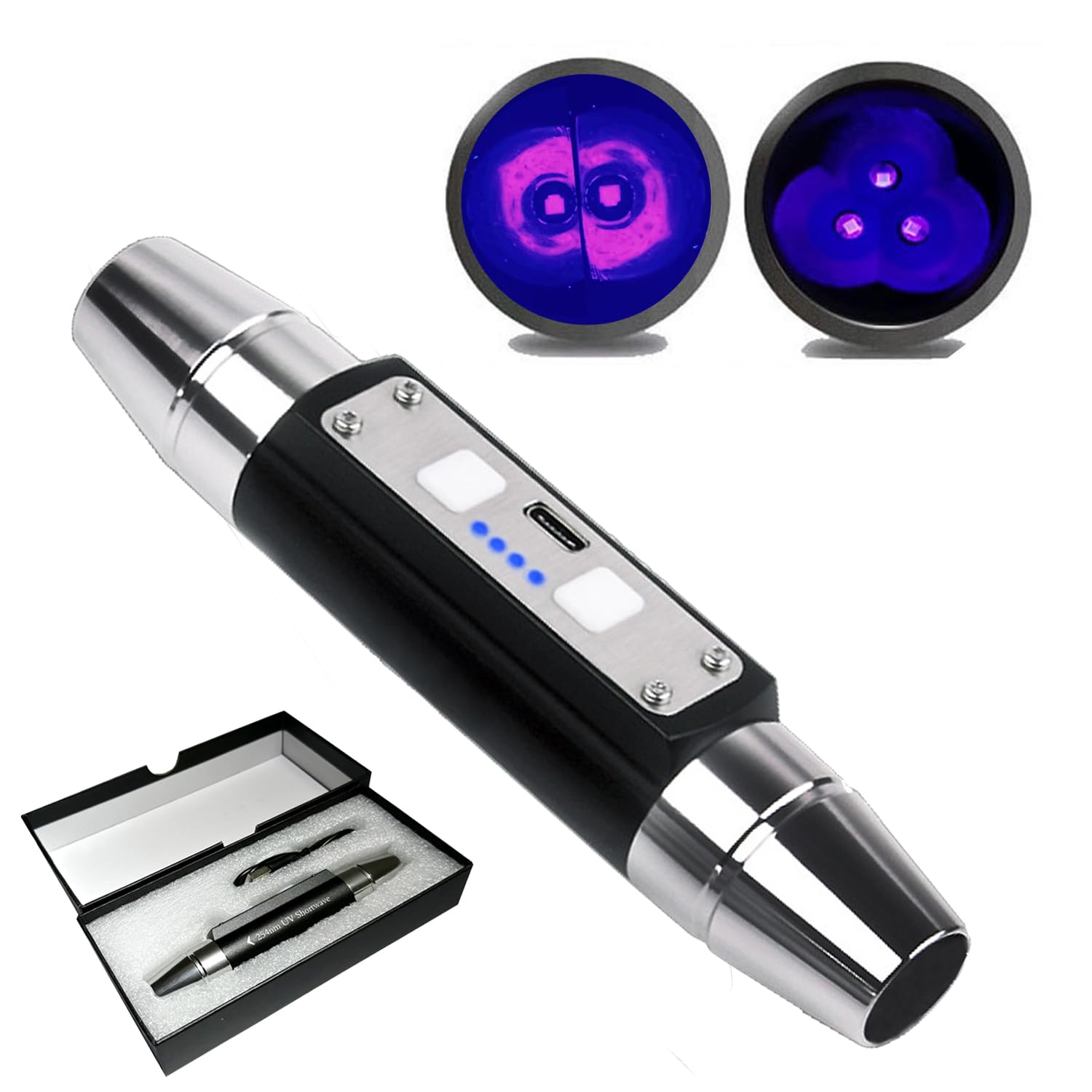
I picked up Shortwave 254nm UVC & Longwave 395nm 365nm UVA LED Flashlight because it is another dual wavelength torch with a filter glass, and I wanted to compare it directly with the WONDSUNSON model I tested first. The shortwave beam made my calcite glow a strong pink, and the longwave beam handled yooperlites well. The filter glass cuts the visible purple light, so the fluorescence stands out clearly in photos. It feels well made, and the torch fits comfortably in one hand. —Justin Cole
I grabbed Shortwave 254nm UVC & Longwave 395nm 365nm UVA LED Flashlight for a second collecting trip, and it performed almost identically to the first WONDSUNSON torch, which makes sense since the design is so similar. The beam is bright, the battery life is good, and the torch survived a drop onto gravel without a scratch. The main difference I noticed was the beam pattern, which is slightly wider here, making it better for scanning a tray than for pinpointing a single stone. —Hannah Brooks
I tried Shortwave 254nm UVC & Longwave 395nm 365nm UVA LED Flashlight on stamps and banknotes too, since the listing mentions counterfeit detection, and the UV beam revealed the security features clearly. It is a versatile torch that covers minerals, stamps, and general UV work in one tool. If the first WONDSUNSON model is out of stock, this one is a near identical backup that does the same job just as well. —Tyler Bennett
Get It From Amazon Now: Check Price on Amazon & FREE Returns
Why Short Wave Uv Light for Minerals Is Necessary
A short wave UV light matters because many minerals only fluoresce under 254nm light, and a longwave torch simply will not show them. Calcite, willemite, and several other minerals glow in vivid colours under shortwave, while staying dull under longwave. Without the right wavelength, a collector walks past treasures without ever knowing they were there.
The wavelength also matters because different minerals respond to different light. Yooperlites glow best under 365nm longwave, while calcite needs shortwave. A dual wavelength torch covers both, which is why I tested several of them here. Knowing which wavelength your target mineral needs saves money and frustration.
Finally, the filter and the beam quality matter because raw UV light washes out the glow with purple glare. A good filter glass blocks the visible light and lets the fluorescence shine, and a tight beam reaches further in the dark. The best torch is the one that matches your minerals, your hunting style, and your eyes.
My Buying Guides on Short Wave Uv Light for Minerals
Why I Looked for Short Wave Uv Light for Minerals
My rock collection looked dull under normal light, and I had read that calcite and yooperlites glow under UV. I wanted a light that would reveal that hidden colour.
I also wanted to compare shortwave and longwave, since different minerals need different wavelengths.
What I Check Before Buying
First I check the wavelength, since 254nm shortwave and 365nm longwave reveal different minerals.
Then I check whether the torch has a filter glass, because unfiltered UV washes out the glow.
My Preference for Dual Wavelength or Single Wavelength Torches
I prefer a dual wavelength torch when I collect many kinds of minerals, since it covers both shortwave and longwave.
A single wavelength torch only makes sense to me when I hunt one mineral, like yooperlites, and want the brightest beam for it.
What I Look for in Quality
I look for a true stated wavelength, a filter that cuts purple glare, and a beam that stays bright at a distance.
Rechargeable batteries and a sturdy body matter too, since these torches get used outdoors at night.
How I Compare Prices
I compare the torch against buying two separate lights, since a dual wavelength model often costs less than two singles.
I also weigh battery life, because a torch that dies mid hunt is useless no matter how bright it is.
My Tips for Choosing the Right One
Test the torch in a truly dark room first, and bring the minerals you actually collect.
Wear UV safety glasses, and never shine the beam into anyone's eyes.
Final Thoughts
After testing these five, my honest view is that the WONDSUNSON dual wavelength torch is the best all rounder for a collector who wants both shortwave and longwave, while the LUMENSHOOTER is the best dedicated longwave torch for yooperlite hunting. The Ausbond is the most powerful for serious night hunting, and the budget dual wavelength torch is the best first buy. Match the wavelength to your minerals, and the glow will find you.
If you only buy one thing, I would start with a dual wavelength torch with a filter glass, then test it on your own collection in the dark before your first field trip. Check which of your rocks glow under each wavelength, and note the ones that only respond to shortwave. Once you know that, you will know exactly what to hunt for.